FAQs
Where did Montessori education originate?
Montessori education was founded in 1907 by Dr Maria Montessori, Italy’s first female physician. Through careful scientific observation, she discovered that children learn best when they are free to explore within a thoughtfully prepared environment. Rather than being taught through instruction alone, children actively construct their own understanding through purposeful work.
From its beginnings in the slums of Rome, with the poorest of children, Montessori education has grown into a globally recognised approach, serving children from birth through adolescence.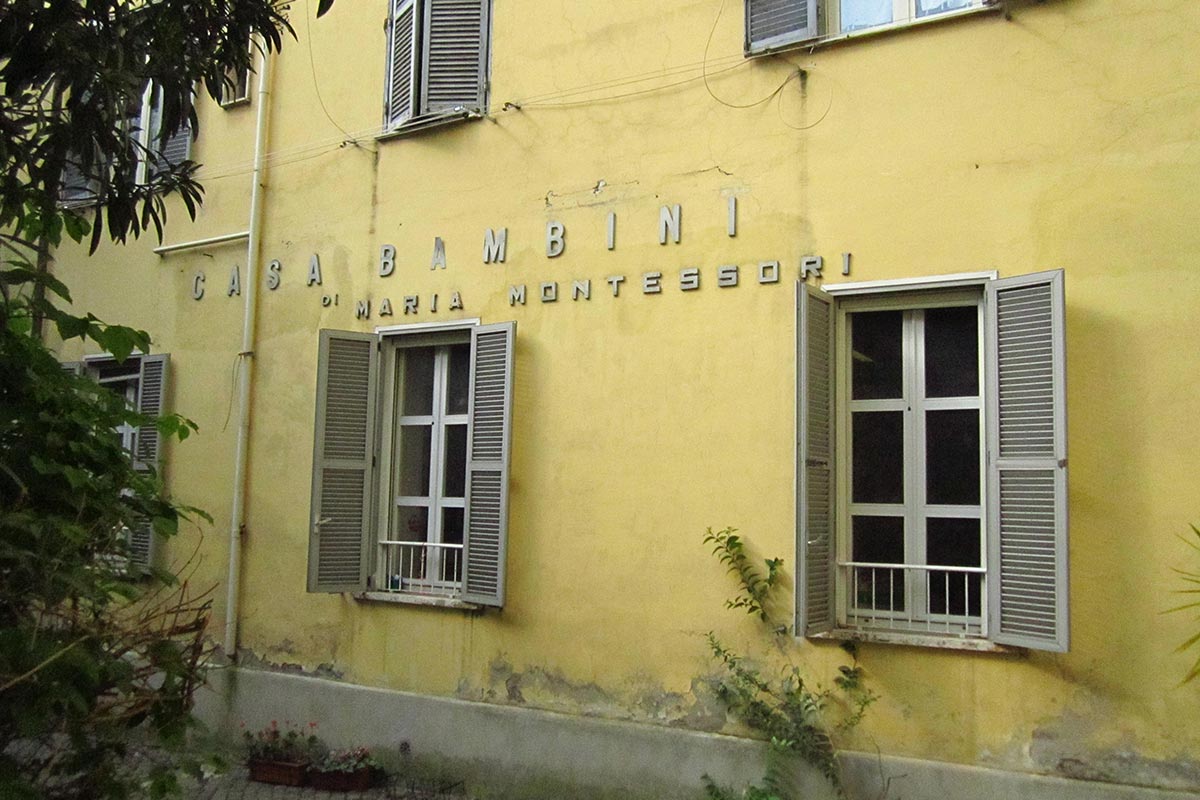
The original Casa dei Bambini (House of Children) is still a functioning Montessori school.
How does Montessori differ from traditional education?
Montessori education looks and feels different from conventional classrooms. Children work independently and collaboratively, move freely within the environment, and engage deeply with meaningful tasks. Teachers guide learning through observation, individual lessons, and small-group work rather than constant whole-class instruction.
The atmosphere is often described as ‘busy and calm’. Classrooms are spaces of focused, purposeful and respectful work. Social-emotional learning, responsibility, and a strong sense of interconnectedness are woven naturally into daily life.
Do Montessori teachers assess or mark children’s work?
Assessment is ongoing, and is done through a combination of observation, detailed records, and work one-on-one with students to support growth and mastery. Formal testing only starts in the Middle school in preparation for the Cambridge years.
This approach respects each child’s effort and learning process, while ensuring that progress is carefully monitored and individual needs are met.
Is Montessori education internationally recognised?
Absolutely. Montessori education is practised in thousands of schools across the world and is widely respected as a rigorous, child-centred approach to education. It is particularly valued by families seeking a global outlook, strong academic foundations, and the development of independent, socially responsible learners.
Are Montessori schools religious?
Most Montessori schools are non-denominational. Some operate within religious communities, while many like ours, are independent.
Although no formal religious instruction is offered, children are encouraged to explore world religions, cultures, and belief systems as part of their growing understanding of humanity and global citizenship, particularly in the upper primary and adolescent years.
What training do Montessori teachers receive?
Montessori teachers complete specialised training aligned with international Montessori standards. The Montessori Academy and College has been a member of the South African Montessori Association since its inception in 2003.
At adolescent level, teachers hold recognised teaching qualifications and receive ongoing professional development and in-house training in Montessori pedagogy.
Are Montessori children successful later in life?
Research consistently shows that Montessori-educated children are well prepared academically, socially, and emotionally. Studies indicate strong outcomes in problem-solving, self-regulation, collaboration, and adaptability.
Families interested in the research are encouraged to read Montessori: The Science Behind the Genius by Dr Angeline Stoll Lillard, which explores these findings in depth.
Do Montessori materials limit creativity?
On the contrary. Montessori materials introduce key concepts clearly and precisely. Once these concepts are mastered, children are encouraged to extend, combine, and explore ideas independently.
Creativity in Montessori education is not about producing identical outcomes, but about fostering original thinking, individual expression, and meaningful work that reflects each child’s unique perspective.
Does Montessori prepare children for exams and tertiary education?
Yes. Montessori education builds strong academic foundations, executive functioning skills, and intrinsic motivation. These are qualities essential for success in formal assessments and further education. Our High School follows the Cambridge IGCSE and A-Level programmes, ensuring international recognition and academic rigour.
What role do parents play in Montessori education?
Parents are valued partners in their child’s education. Open communication, shared understanding of Montessori principles, and consistency between home and school support the child’s development and independence.
Can children transition easily from Montessori to traditional schools or universities?
Yes. Montessori students typically transition well due to their independence, adaptability, strong study habits, and confidence in learning. These skills serve them well in any educational setting.
Students who complete the appropriate IGCSE and A-Level programme must obtain a USAf exemption to ensure eligibility for admission to South African universities.
Is Montessori suitable for all children?
Montessori education benefits a wide range of learners. Its individualised approach allows children to progress at their own pace while being appropriately challenged and supported. Suitability is enhanced when parents and teachers work together in the best interests of the child.